
Home / Industries / Grocery store billing software
Grocery · Kirana · General store
Grocery store billing software for kirana and general stores
By the er4u team · Last updated
Short answer: er4u is grocery billing software built for Indian kirana and general stores. It bills packed items by barcode and loose items straight from a weighing scale on the same bill, tracks stock with batch and expiry dates, keeps udhaar (customer credit) accounts, and prints a GST tax invoice or a composition-scheme bill of supply. Plans start at ₹5,000 + GST for the first year offline, or ₹7,000 + GST online.
At the counter
What does a grocery shop need from billing software?
A grocery counter is different from a garment or electronics counter: dozens of low-value items per bill, some packed and some loose, regular customers on credit, and stock that expires. Use this list to judge any software you shortlist.
| Need | Why it matters in a grocery shop | In er4u |
|---|---|---|
| Fast barcode billing | The evening queue moves only as fast as scan-to-print. | Barcode billing, keyboard shortcuts, and hold & resume bills, on every plan |
| Loose items by weight | Rice, dal, sugar and dry fruit are sold by the gram, not by the packet. | The scale's reading goes straight into the bill, or weight-embedded barcode stickers are scanned; one-time ₹4,000 + GST for up to 5 devices |
| Boxes, packets and pieces | Biscuits and soap sell by the piece and by the box. | Multi-unit sales with automatic unit conversion and price scaling |
| Udhaar (customer credit) | Regular customers settle at month end, and a notebook loses track. | Running balance per customer on every plan, with daily and per-bill credit limits; SMS due reminders on Premium and above |
| Expiry and batches | Expired stock on the shelf is lost money and a complaint waiting to happen. | Batch, MFG and expiry captured at purchase, expired stock blocked at inward, expiry alerts |
| MRP and rate changes | Distributors change MRP often, and old labels cost margin. | Bulk MRP and tax grid at purchase, MRP and selling price on labels, MRP and margin visible while billing |
| The right GST document | Regular-scheme and composition shops must issue different bills. | GST tax invoice or composition bill of supply, GSTIN verification, and GST returns in Excel, CSV and JSON, on every plan |
| Offers and combos | Buy-2-get-1 and combo packs bring people back. | Automatic schemes, combos and buy-one-get-one offers on Premium and above |
| UPI, card and cash | Customers pay every way, often split across two. | Multiple payment modes and bill QR on every plan; PhonePe dynamic QR and EDC auto-payments on online Enterprise plans and above |
| Bills on WhatsApp | Saves paper and keeps your shop's number in the customer's phone. | Share on WhatsApp on every plan; automatic from your own number on Enterprise and above |
| Home delivery | Nearby homes order by phone and WhatsApp. | Easy Delivery App for your own riders (₹10,000 + GST, one-time); branded website on Enterprise Max |
| Stock audit | Counting shelves on paper takes a whole day. | Easy Audit Android app on online Enterprise plans and above |
Loose items
How do you bill loose items sold by weight?
There are two ways, and er4u supports both. In the first, the scale sits at the billing counter and its reading goes straight into the bill, so the item is weighed and billed in one step. In the second, staff weigh items at a separate scale that prints a sticker with the weight inside the barcode, and the cashier simply scans it. Packed items still scan on their own barcodes, so one bill can mix a kilo of loose sugar with a packet of biscuits.
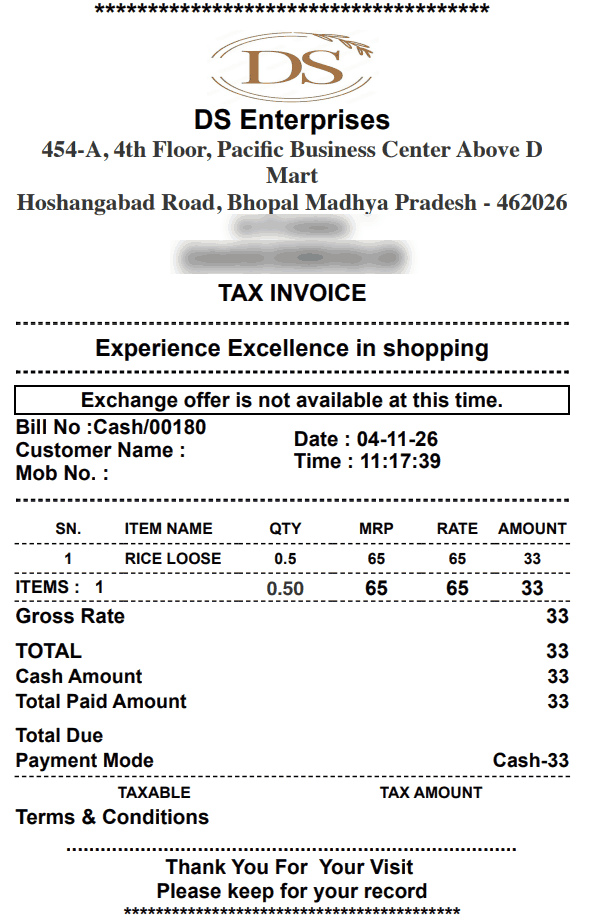
- Integration: ₹4,000 + GST, one time, for up to 5 devices, so one charge usually covers the whole shop.
- The scale: er4u supplies the Phoenix NPW 30 kg scale at ₹6,500 including tax, and Essae scales that print weight-embedded barcode labels.
- Legal Metrology: a scale used to sell by weight must be verified and stamped under the Legal Metrology Act, 2009, and re-verified at the intervals your state's Legal Metrology department sets. The Phoenix scale er4u supplies comes verified and stamped by Nitiraj Engineers Ltd.
More detail, including how weight-embedded barcodes work, is on the weighing and billing software page.
GST
Tax invoice or bill of supply: what should a grocery shop issue?
It depends on how your shop is registered under GST. Many small grocery shops choose the composition scheme because it is simpler; larger shops and those selling to other businesses usually stay on the regular scheme. er4u prints the right document for either, on every plan.
| Regular scheme | Composition scheme | |
|---|---|---|
| Who can use it | Any GST-registered shop | Traders with aggregate turnover up to ₹1.5 crore (₹75 lakh in the North-Eastern states and Himachal Pradesh) |
| Bill you issue | Tax invoice showing GST on each item | Bill of supply with no GST, marked "composition taxable person, not eligible to collect tax on supplies" |
| Tax you pay | GST collected, minus input tax credit | 1% of turnover (0.5% CGST + 0.5% SGST) |
| Input tax credit | Yes | No |
| Sales to other states | Allowed | Not allowed |
| Returns | GSTR-1 and GSTR-3B, monthly or quarterly | CMP-08 every quarter, GSTR-4 once a year |
Rates differ for loose and packed versions of the same item. Loose, unbranded rice, atta and dal are generally exempt, while pre-packaged and labelled versions attract 5%. Rates on many grocery items changed on 22 September 2025; ghee, butter and packaged namkeen, for example, moved from 12% to 5%. Keep the HSN code and GST rate on every item in your item master current, and confirm anything unclear with your CA or on the CBIC website.
In er4u, supplier and customer GSTIN verification and GST return export (Excel, CSV and JSON) are on every plan. See GST billing software for invoice formats.
Udhaar
How do you manage udhaar without a notebook?
Credit to regular customers keeps a neighbourhood shop's business, but a notebook can't tell you who has gone 60 days without paying. In er4u, a sale on credit goes to that customer's account automatically, and every part payment reduces the balance.
- Running balance per customer, with every bill and payment listed, on every plan.
- Credit limits, daily and per bill, so staff can't extend more credit than you allow.
- Due reminders by SMS on Premium and above (1,000 transactional SMS on Premium, 5,000 on Enterprise).
- Purchase history for each customer at the counter, so the cashier knows a regular before the bill starts.
Plans
Which er4u plan suits a grocery shop?
Every plan includes barcode billing, GST or composition bills, purchase and inventory, accounts, udhaar and unlimited invoices, with unlimited training and support. Prices are for the first year, plus 18% GST, with a smaller renewal from the second year.
Single-counter kirana, 1–3 staff
Startup Off: ₹5,000 offline (renews ₹1,500) or Startup: ₹7,000 online (renews ₹2,000). 3 users and one outlet.
Offers, loyalty and reminders
Premium Off: ₹9,000 offline or Premium: ₹11,200 online. 10 users, plus automatic schemes, loyalty and membership, SMS bills and due reminders.
Several counters
Enterprise Off: ₹12,000 offline or Enterprise: ₹15,400 online. Unlimited users, cash register and shift management, and automatic WhatsApp bills. Online Enterprise adds the audit and order apps and PhonePe auto-payments.
Delivering to homes
The Easy Delivery App for your own riders is ₹10,000, one-time. Enterprise Max: ₹21,000 online adds a branded eCommerce website that shares stock with the counter.
A second shop
Add outlets to any plan from ₹3,000 offline or ₹4,900 online per outlet for the first year, with one-click outlet-to-outlet billing for transfers between your stores.
Pay once for 10 years
10-year plans with no renewal for a decade start at ₹11,000 offline and ₹15,000 online.
Worked example: a kirana shop on Startup Off with a weighing scale pays ₹5,000 for the software and ₹4,000 for scale integration in year one, then ₹1,500 in each of years two and three: ₹12,000 + GST over three years, plus ₹6,500 (tax included) for the Phoenix scale. Thermal receipt printers and barcode scanners from er4u start at ₹2,500 and ₹3,000 including GST; see retail hardware.
Free software
Is free grocery billing software worth it?
Free billing apps can suit a very small shop with one phone and a handful of bills a day. Once you have staff, loose items and customers on credit, check these before you rely on one:
- GST updates: does it change rates when the law changes, as it did on 22 September 2025?
- Loose items: can it read a weighing scale, or does every weight get typed by hand?
- Backups: if the phone or PC is lost, is your data, including udhaar balances, recoverable?
- Staff controls: can a cashier be stopped from deleting bills or changing rates?
- Support: who answers when billing stops on a Sunday morning, and in which language?
Avoid "free download" copies of paid software: they get no updates or support and can carry malware. er4u is paid software, but you can see it first in a free live demo, learn from 90+ training videos in Hindi and English, and buy with a 30-day money-back policy on the conditions in our refund policy.
Demo checklist
What should you test in a grocery billing demo?
Bring a list of your own items, packed and loose, and ask every vendor to do these live:
- Bill a 20-item basket that mixes barcoded packets and loose items weighed on the scale. Time it.
- Sell the same product by the piece and by the box, and check stock afterwards.
- Bill a regular customer on udhaar, take a part payment, and show the balance.
- Enter a purchase with batch and expiry dates and see the expiry alert.
- Change the MRP on an item and print new labels.
- Print the bill your registration needs: a tax invoice, or a bill of supply if you are under composition.
- Take a split payment (cash + UPI) and close the day.
- On an offline plan, unplug the internet and keep billing.
er4u runs free demos over Google Meet, TeamViewer or AnyDesk. For a wider checklist, see the retail billing software buyer's guide.
In use
Grocery stores and marts that bill on er4u
er4u is used by 20,000+ businesses across 300+ sectors, including grocery stores, supermarts and departmental stores. A few of them:
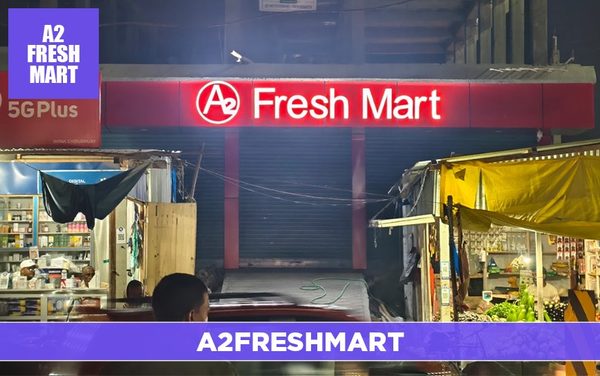
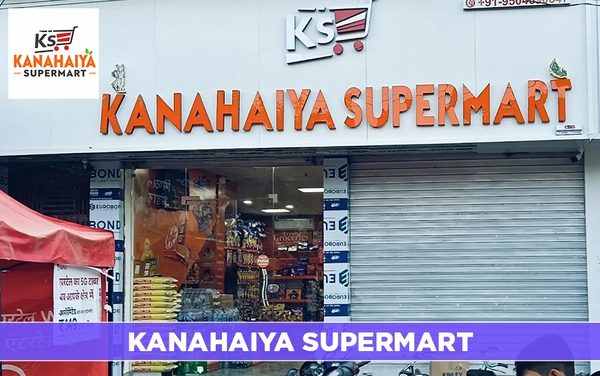
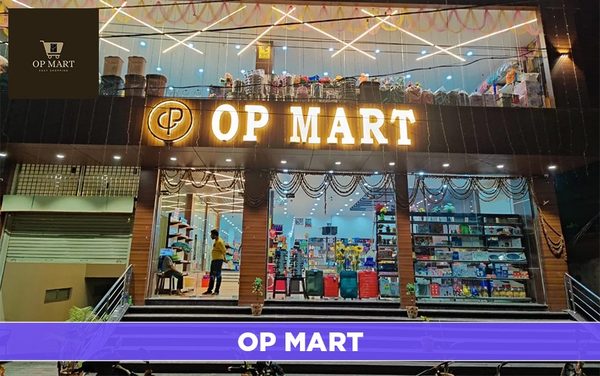
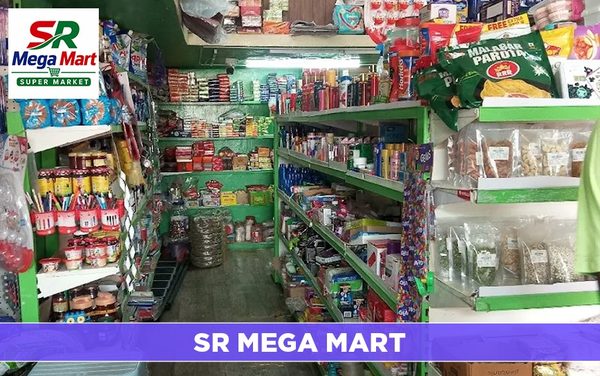
Hear owners on video, including Maa Vaishno Departmental Store, on the client reviews page, or browse clients state by state.
FAQ
Frequently asked questions
Which is the best billing software for a grocery store?
The best grocery billing software bills packed items by barcode and loose items by weight on the same bill, keeps stock and expiry dates accurate, handles udhaar, prints the right GST document for your registration and keeps billing when the internet drops. er4u does all of this for kirana, general and grocery stores, with offline plans from ₹5,000 + GST and online plans from ₹7,000 + GST for the first year. Test any shortlist with your own items in a free demo.
Can er4u bill loose items sold by weight?
Yes. With weighing-scale integration, er4u reads the weight from the scale into the bill, or decodes weight-embedded barcode stickers printed by the scale. Integration is a one-time ₹4,000 + GST for up to 5 devices, and er4u supplies the Phoenix NPW 30 kg scale at ₹6,500 including tax, verified and stamped by Nitiraj Engineers Ltd.
Does er4u work for shops under the GST composition scheme?
Yes. On every plan er4u prints a bill of supply without GST for composition dealers, and a GST tax invoice for shops under the regular scheme. Under composition, a trader with aggregate turnover up to ₹1.5 crore (₹75 lakh in the North-Eastern states and Himachal Pradesh) pays 1% of turnover and cannot charge GST to customers.
Can I keep udhaar (credit) accounts for customers?
Yes. Every er4u plan keeps a running credit balance for each customer, so you can see who owes what and record part payments. You can set credit limits, and Premium plans and above can send SMS due reminders.
Does grocery billing software work without internet?
er4u's offline plans run on your own PC, so billing carries on when the internet is down. A few features need a connection: WhatsApp and SMS alerts, GSTIN verification, and e-way bills or e-invoices. Online plans run in the cloud, so you can check sales and stock away from the shop.
How much does grocery billing software cost in India?
On er4u, Startup Off costs ₹5,000 + GST for the first year offline and Startup ₹7,000 + GST online, both for 3 users, renewing at ₹1,500 or ₹2,000 + GST a year. Weighing-scale integration is a one-time ₹4,000 + GST. 10-year plans start at ₹11,000 + GST offline and ₹15,000 + GST online.
Is there free grocery billing software?
Free mobile apps exist and can suit a very small shop. Before relying on one, check whether it handles loose items by weight, GST rate changes, backups, several users and support in your language. Free-download copies of paid software get no updates or support and can carry malware. er4u is paid, but gives a free live demo, 90+ training videos and a 30-day money-back policy on the conditions in its refund policy.
Can a grocery store take home delivery orders with er4u?
Yes. The Easy Delivery App (₹10,000 + GST, one-time) lets your own delivery staff handle orders, and Enterprise Max adds a branded eCommerce website on your own domain that shares stock with the counter.
Does er4u track expiry dates?
Yes. Batch, manufacturing and expiry dates are captured at purchase, expired stock can be blocked at inward, and er4u sends automatic expiry alerts. Barcode labels can carry the MRP and expiry date.
Related: Weighing and billing software · Supermarket billing software · Retail billing software buyer's guide · GST billing software · Plans & pricing
See er4u bill your own grocery items
Bring a list of your items to a free live demo and watch a real basket billed: packed and loose, on udhaar, with a WhatsApp bill. Plans from ₹5,000 + GST a year.
Book a free demo