

In the ever-evolving landscape of business technology, weighing scale integration in billing software stands out as a pivotal advancement — particularly in industries where product weight directly influences billing. This integration merges weight measurement with financial transactions, simplifying operations and significantly boosting accuracy compared to conventional billing methods.
How weighing scale integration changes billing
The integration streamlines the billing process by automatically capturing and calculating charges based on the weight of goods. This not only enhances accuracy but also speeds up the billing cycle, reducing manual errors and improving operational efficiency.
- Automated weight data capture: weight flows straight from the scale into the bill, eliminating manual entry and the errors that come with it
- Real-time billing accuracy: invoices reflect exact charges based on actual weight, building customer trust and satisfaction
- Faster billing cycles: quicker invoice generation means faster payment cycles and shorter queues
The two ways a weight reaches the bill
Shops run one of two flows, and er4u handles both. Which one you need depends on whether the customer weighs goods at a counter scale before paying, or the staff weigh at the billing counter itself.
- Weight-embedded barcode. The scale weighs the item and prints a sticker whose barcode has the weight encoded inside it. At the counter the operator simply scans that sticker — er4u decodes the weight out of the barcode, applies the item’s rate and puts the line on the bill. This is the flow most supermarkets use, because the weighing happens away from the till and the queue keeps moving.
- Scale connected to the billing PC. The weight machine sits at the counter and feeds the reading straight into the billing screen, so loose items are weighed and billed in the same motion.
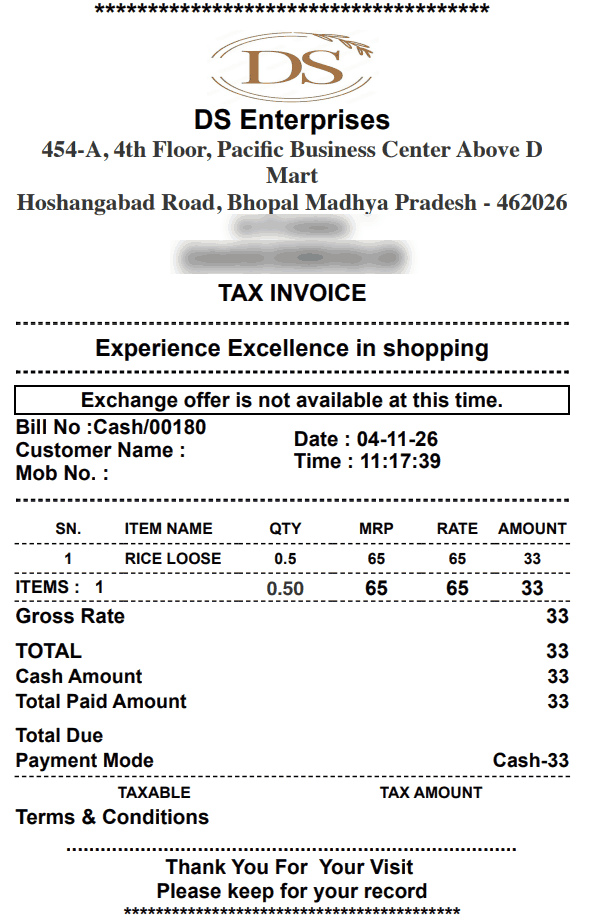
Either way, packed items still scan on their own barcode. A single bill can mix both — a bag of rice weighed loose and a packed biscuit carton — without switching screens.
What the hardware costs, and what you need to buy
er4u has a direct arrangement with Phoenix, so the scale and its integration come from one place rather than being pieced together:
- Phoenix NPW 30 kg weight machine — ₹6,500 including tax. Backlit LED display. er4u supplies the complete setup at that price.
- The cable. The Phoenix unit ships with a serial cable, so a serial-to-USB converter is needed alongside it — it is part of the kit er4u supplies. The scale then connects to the billing PC over USB.
- Weight scale integration — ₹4,000 + 18% GST, one time, for up to 5 devices. A single charge covers the outlet, not each counter.
- Essae scales with built-in barcode printing are also supported for shops that want the scale itself to print the weight-embedded stickers.
Full specifications are on the retail hardware page, and the integration charge is listed with the other one-time add-ons on the add-ons page.
Who benefits from weighing + billing in one system?
Any business that sells products by weight benefits from this integration:
- Grocery, kirana & supermarkets: loose grains, vegetables, dry fruits and staples billed in one scan-and-weigh flow
- Meat & seafood markets: precise per-kg billing with GST handled automatically
- Bulk food & agricultural businesses: quintal-to-kg conversions without spreadsheets
- Logistics & transportation: accurate billing where charges depend on shipment weight
- Manufacturing & industrial suppliers: materials like metals or chemicals sold by weight, billed precisely
Implementing weighing scale integration the right way
The implementation process involves selecting billing software that supports weighing scale integration, ensuring compatibility with your existing scales, and training staff for seamless operation. Choose software that offers scalability and flexibility — and plan for thorough testing and regular calibration of weight scales to keep data accurate.
er4u supports weight + barcode mixed billing in a single flow — packed items scan by barcode while loose items come from the scale (Phoenix and Essae scales are sold and integrated by er4u, with weight-scale integration at ₹4,000+GST for up to 5 devices). Discover these features with er4u's department store billing software — see supported hardware and plans.
Frequently asked questions
Which businesses benefit from weighing scale integration?
Any business selling products by weight: grocery stores, meat and seafood markets, bulk food stores, agricultural businesses, and industrial suppliers selling materials like metals or chemicals by weight.
Does er4u support both barcode and weight-based billing?
Yes — er4u handles packed (barcode) and loose (weighed) items in a single billing flow, with weighing scale integration for up to 5 devices per outlet.
What are the main challenges of scale integration?
Ensuring data accuracy and system compatibility — overcome with thorough testing, regular scale calibration, and software updated to handle various scale models.
Does er4u read weight-embedded barcodes from a weighing scale?
Yes. When the scale prints a sticker with the weight encoded inside the barcode, er4u decodes that weight at the counter, applies the item’s rate and puts the line straight on the bill. The operator only scans the sticker — no weight is typed in.
How does a weighing scale connect to er4u?
Over USB. The Phoenix unit ships with a serial cable, so a serial-to-USB converter is used alongside it; er4u supplies the complete setup. Once connected, the reading goes from the scale into the billing screen directly.
What does weighing scale integration cost in er4u?
The Phoenix NPW 30 kg weight machine is ₹6,500 including tax, supplied by er4u. Weight scale integration is a one-time ₹4,000 + 18% GST and covers up to 5 devices, so one charge usually covers the whole outlet.
Can one bill contain both weighed and packed items?
Yes. Loose items come from the scale or its weight-embedded sticker and packed items scan on their own barcode, on the same bill, without switching screens.
Which weighing scales work with er4u?
Phoenix NPW 30 kg, supplied directly by er4u, and Essae scales with built-in barcode printing for shops that want the scale to print weight-embedded stickers itself.
Related reading: Grocery & kirana store billing software · Best billing software and invoicing system with GST — er4u · Best supermarket billing software — with a free demo · Garment shop management software
See er4u on your own store type
Judge it live — free demo via Google Meet, TeamViewer or AnyDesk. Plans from ₹5,000+GST/year.
Book a free demo